Back to exercises
Running
Tempo Run
A sustained block of comfortably hard running that teaches your body to hold a strong pace without tipping into the red. The classic workout for raising your lactate threshold.
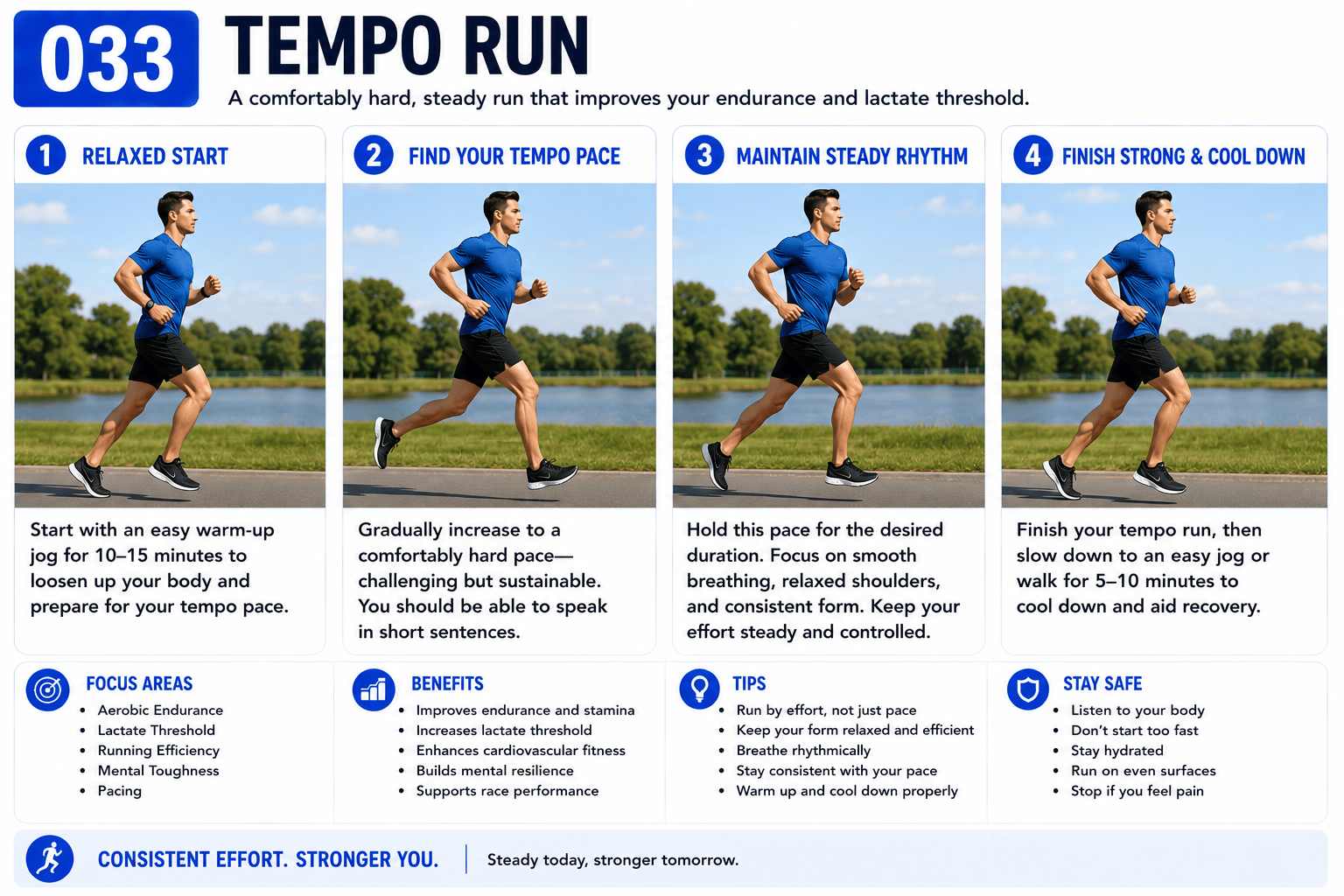
Photo guide
Alblooshi Fit
Media metadata
Provider: Alblooshi Fit atlas photo guide
Thumbnail: Photo guide
Reviewed video attachments can be managed from the admin panel. Alblooshi Fit does not scrape or re-host copyrighted exercise videos.
Suggested use
Distance
6.00 km
Running
Intermediate
Endurance
Cardio
Gait
Muscles worked
Primary
Cardiovascular system
Secondary
Quads
Hamstrings
Glutes
Calves
Hip flexors
Equipment
Track or road
How to do it
- Warm up with 10 minutes of easy jogging plus a few strides.
- Build into a comfortably hard pace — about 7 out of 10 effort, or a pace you could hold for roughly an hour in a race.
- As a pace guide, run about 25-40 seconds per kilometer slower than your 5K pace.
- Hold that pace for 15-20 minutes, staying tall with relaxed shoulders and quick, light steps.
- Use the talk test: one short sentence at a time is right — chatting freely means too easy, no words at all means too hard.
- Cool down with 5-10 minutes of easy jogging or walking.
Common mistakes
- Starting too fast and fading — a tempo should be even or slightly faster at the end.
- Turning it into a race effort instead of controlled discomfort.
- Skipping the warm-up and asking cold legs for threshold pace.
- Straining the face, neck and shoulders as the effort builds.
Safety first
- Earn tempo work with several weeks of consistent easy running first.
- Cut the tempo short if your form falls apart or pain appears — the pace only counts when it is controlled.
- Hydrate beforehand and shorten the block in hot conditions.
Who should avoid or modify
- Known heart condition, chest pain history or uncontrolled blood pressure — consult a licensed clinician before sustained hard efforts.
- Recent lower-limb injury — rebuild an easy-run base first and consult a licensed clinician if unsure.
- Pregnancy — sustained hard efforts often need modification; consult a licensed clinician.
- Stop immediately if you feel chest pain, dizziness or severe shortness of breath.
Breathing and tempo
Breathing: A steady 2:2 rhythm (inhale two steps, exhale two steps) usually matches tempo effort well.
Tempo: Comfortably hard and metronome-steady — the goal is control, not collapse.